
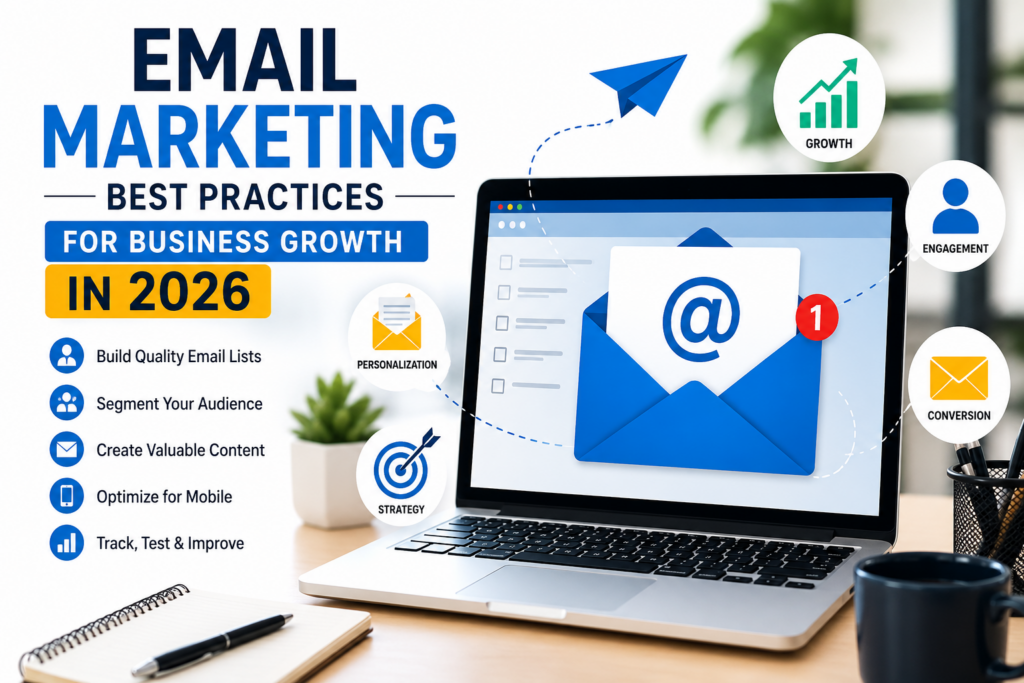
Email Marketing Best Practices for Business Growth in 2026
Introduction
Email Marketing Best Practices remain one of the most effective digital marketing strategies for businesses in 2026. While social media platforms, search engines, and paid advertising continue to evolve, following Email Marketing Best Practices helps businesses consistently achieve strong results by communicating directly with customers. These practices provide opportunities to build relationships, share valuable information, promote products and services, and encourage long-term customer loyalty.
Unlike many other marketing channels, email marketing allows businesses to reach their audience in a personalized and cost-effective way. Whether you own a small business, startup, or large organization, a well-planned email marketing strategy can help increase customer engagement, generate leads, and improve sales performance.
In this article, we will explore the best email marketing practices that can help businesses achieve long-term growth and success in 2026.
What is Email Marketing and Email Marketing Best Practices?
Email marketing is a digital marketing strategy that involves sending emails to potential and existing customers. These emails may include promotional offers, newsletters, product updates, educational content, event invitations, and other valuable information.
The primary goal of email marketing is to build strong customer relationships while encouraging users to take specific actions, such as making a purchase, signing up for a service, or visiting a website.
When implemented correctly, email marketing can become one of the most valuable tools in a company’s marketing strategy.
Why Email Marketing Best Practices Matter for Businesses
Email marketing continues to be important because it offers direct communication with customers. Unlike social media platforms where algorithms control visibility, emails are delivered directly to subscribers’ inboxes.
Some key benefits of email marketing include:
- Direct communication with customers
- Higher customer engagement
- Increased website traffic
- Better lead nurturing
- Improved customer retention
- Cost-effective marketing
- Measurable campaign performance
Businesses that consistently use email marketing often see stronger customer relationships and higher conversion rates.
Best Practice 1: Build a Quality Email List
Email Marketing Best Practices for Building a Quality Email List
The foundation of successful email marketing is a high-quality email list.
Businesses should focus on collecting email addresses from people who are genuinely interested in their products or services. This can be done through:
- Website contact forms
- Newsletter subscriptions
- Free resources and downloads
- Event registrations
- Customer inquiries
Avoid purchasing email lists because they often contain unqualified contacts who may not be interested in your business.
A quality email list leads to better engagement and stronger marketing results.
Best Practice 2: Segment Your Audience
Email Marketing Best Practices for Audience Segmentation
Not all customers have the same interests or needs.
Audience segmentation involves dividing subscribers into different groups based on factors such as:
- Demographics
- Interests
- Purchase history
- Location
- Customer behavior
By sending targeted emails to specific groups, businesses can deliver more relevant content and improve engagement rates.
Personalized communication often produces better results than sending the same email to everyone.
Best Practice 3: Create Valuable Content
Email Marketing Best Practices for Creating Valuable Content
One of the biggest mistakes businesses make is focusing only on sales promotions.
Successful email marketing provides value to subscribers through useful and informative content.
Examples include:
- Industry insights
- Helpful tips
- Educational articles
- Product guides
- Business updates
- Customer success stories
When subscribers find your emails valuable, they are more likely to remain engaged and continue opening future messages.
Best Practice 4: Write Compelling Subject Lines
Email Marketing Best Practices for Subject Lines
The subject line is the first thing recipients see when they receive an email.
A strong subject line can significantly improve open rates.
Effective subject lines should be:
- Clear
- Relevant
- Concise
- Engaging
Examples:
- 5 Email Marketing Tips for Business Growth
- Discover How to Improve Customer Engagement
- Simple Strategies to Increase Website Traffic
Avoid misleading subject lines because they can reduce trust and increase unsubscribe rates.
Best Practice 5: Personalize Your Emails
Email Marketing Best Practices for Personalization
Personalization helps create a more meaningful experience for subscribers.
Simple personalization techniques include:
- Using the recipient’s name
- Recommending relevant products or services
- Sending location-specific information
- Providing personalized offers
Personalized emails often generate higher engagement because they feel more relevant to the recipient.
Customers appreciate businesses that understand their needs and preferences.
Best Practice 6: Email Marketing Best Practices for Mobile Optimization
A large percentage of emails are opened on smartphones and tablets.
If emails are not mobile-friendly, users may quickly leave or delete them.
To improve mobile performance:
- Use responsive email designs
- Keep content easy to read
- Use clear call-to-action buttons
- Avoid large image files
- Test emails on multiple devices
Mobile optimization helps improve user experience and engagement.
Best Practice 7: Email Marketing Best Practices for Effective Calls to Action
Every email should have a clear purpose.
A Call to Action (CTA) tells subscribers what action they should take next.
Examples include:
- Learn More
- Get Free Consultation
- Contact Us Today
- Download Now
- Schedule a Call
The CTA should be visible, easy to understand, and relevant to the content of the email.
A strong CTA can significantly improve conversion rates.
Best Practice 8: Email Marketing Best Practices for Consistent Communication
Consistency is important for building strong customer relationships.
Businesses should establish a regular email schedule and communicate with subscribers consistently.
Examples include:
- Weekly newsletters
- Monthly updates
- Promotional campaigns
- Product announcements
Regular communication helps keep your brand visible and strengthens customer trust.
However, avoid sending too many emails, as excessive communication can lead to unsubscribes.
Best Practice 9: Email Marketing Best Practices for Monitoring Performance
Tracking email performance helps businesses understand what works and what needs improvement.
Important metrics include:
Open Rate
Measures how many recipients open an email.
Click-Through Rate
Measures how many recipients click links within the email.
Conversion Rate
Measures how many recipients complete a desired action.
Unsubscribe Rate
Measures how many subscribers leave the email list.
Analyzing these metrics helps businesses improve future campaigns and achieve better results.
Best Practice 10: Email Marketing Best Practices for Campaign Optimization
Successful email marketing requires continuous optimization.
Businesses should regularly test different elements such as:
- Subject lines
- Email designs
- Content formats
- Call-to-action buttons
- Sending times
A/B testing allows marketers to compare different versions and identify the most effective approach.
Continuous improvement helps maximize campaign performance.
Common Email Marketing Mistakes to Avoid
Sending Irrelevant Content
Subscribers may lose interest if emails do not provide value.
Ignoring Personalization
Generic emails often perform worse than personalized messages.
Using Misleading Subject Lines
Misleading subject lines can damage trust and increase unsubscribe rates.
Overloading Emails with Information
Too much content can overwhelm readers.
Keep emails clear, concise, and focused.
Neglecting Mobile Optimization
Poor mobile experiences can reduce engagement and conversions.
Email Marketing Best Practices for Business Growth
Businesses that follow email marketing best practices can achieve several benefits, including:
- Improved customer engagement
- Increased website traffic
- Higher conversion rates
- Stronger customer loyalty
- Better brand awareness
- More qualified leads
- Cost-effective marketing results
These benefits contribute directly to long-term business growth and success.
The Future of Email Marketing
Email marketing continues to evolve with advancements in technology and customer expectations.
In 2026, businesses are increasingly using:
- Marketing automation
- Artificial intelligence
- Advanced personalization
- Behavioral targeting
- Data-driven decision making
These innovations help businesses deliver more relevant experiences and improve campaign effectiveness.
Companies that adapt to changing trends will remain competitive and continue achieving strong results through email marketing.
Conclusion
Email marketing remains one of the most effective digital marketing strategies for business growth in 2026. It provides a direct, cost-effective, and measurable way to communicate with customers, build relationships, and drive conversions.
By focusing on high-quality email lists, audience segmentation, valuable content, personalization, mobile optimization, and performance tracking, businesses can create successful email marketing campaigns that deliver long-term results.
Whether your goal is to increase customer engagement, generate leads, or improve sales, email marketing can play a vital role in achieving your business objectives.
Visit our Home Page to learn more about our Digital Marketing Services.
Ready to grow your business with effective email marketing strategies? Contact MK Digital Marketing Agency today and discover how our professional Email Marketing Services can help you engage customers, increase conversions, and achieve long-term business growth through targeted and results-driven campaigns.